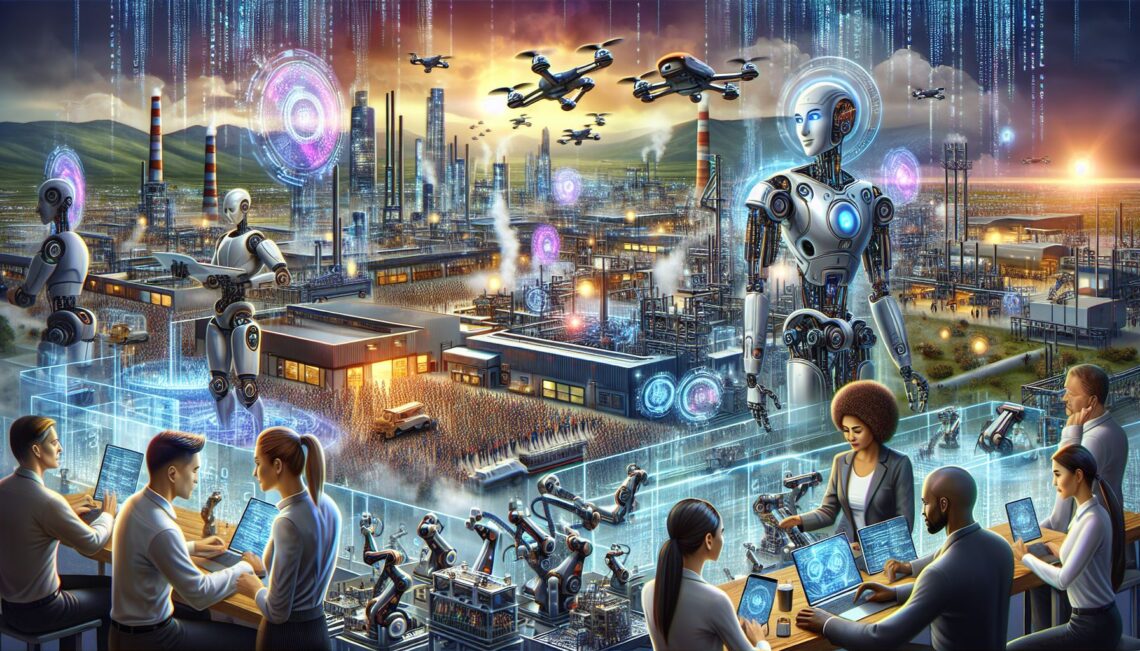
Hey tech aficionados! Today, I’m diving into a topic that feels a bit like sci-fi finally catching up to reality: the Fourth Industrial Revolution. It’s got everything—AI, robotics, IoT, nanotechnology, you name it—and it’s about to reshape our world in ways we’ve only dreamt about. Grab your virtual surfboard ’cause we’re riding the wave of the future!
The Revolution Roller Coaster: A Brief Ride Through History
Let’s rewind a bit. The First Industrial Revolution gave us steam, freeing human and animal labor from back-breaking physical work. The second, fueled by electricity, streamlined production and boosted communications like never before. The third was the era of computers and the Internet—suddenly, the world was connected, and information was just a click away.
Now, we’re standing at the edge of the fourth. So, what makes it special? One word: integration. This revolution doesn’t just bring new tech; it combines emerging technologies across the digital, biological, and physical realms. It’s like the Avengers of innovation. We’ve got AI teaming up with biotech, blockchain, and robotics—all transforming industries in ways we only saw in blockbuster movies.
Battle of the Bots: Robots Beyond Our Wildest Imagination
Let’s talk robots. We’ve come a long way from the clunky, mechanical arms in car factories. Now, they’re sleek, intelligent, and more accessible than ever. Meet Sophia and her robotic relatives—she’s just scratching the surface of humanoid companions of the future. Emojis and online chats already give us social surrogacy, but imagine that evolving into actual, physical interactions. It’s a bit Westworld minus the dystopian chaos (hopefully).
But it’s not just about humanoid robots. Drones are flying, driverless cars are cruising, and AI-powered assistants are taking care of scheduling, grocery lists, and those annoying reminder notes we always neglect.
The Human-Robot Frontier
Let’s think about the human aspect here. There’s always this fear of robots taking over our jobs. It’s the elephant in the room. But here’s the twist. Rather than robots replacing us, think of them as colleagues. Cobots (collaborative robots) are designed to work alongside humans, boosting productivity without edging us out. Imagine a workday where you’re brainstorming with your AI teammates. It’s a collaboration out of a futuristic boardroom.
AI on Steroids: The Game-Changer
Seriously, what isn’t driven by AI these days? The cognitive power of AI has gone beyond winning chess games or Jeopardy. We’re looking at AI that’s revolutionizing sectors from finance to healthcare. It analyzes massive data sets with speed and precision, finding patterns that the human eye easily misses.
Got health concerns? AI might just save your life. We’re seeing systems that diagnose cancer with an accuracy that rivals top oncologists. It’s not putting doctors out of work—it’s giving them better tools to be superheroes without a cape.
Ethics in the Age of AI
Okay, real talk. With great power comes great responsibility. Yes, there’s an ethical mess that shadows this rise. Decisions that affect human lives, driven by AI? That’s a big pill to swallow. The dialogue between techies and ethicists is heating up. How do we balance AI’s power without unleashing a dystopian Pandora’s box?
Beyond Cyberspace: Blockchain’s Big Leap
Most folks hear “blockchain” and think Bitcoin—and sure, cryptocurrency is a headline-grabber. But there’s so much more to this innovation. Blockchain’s decentralized ledger is transforming industries, creating trust and transparency in places often shrouded in opacity.
Finance, yes. But also healthcare, supply chains, and even voting systems. Imagine casting a vote that’s immune to tampering or fraud. Or an inventory system where every product is traceable, ensuring fair labor practices and quality control. Blockchain might not be flashy in your day-to-day life, but its impact runs deep.
Mind the Gap: Bridging Digital and Physical Worlds
Let’s not kid ourselves. The Fourth Industrial Revolution isn’t all smooth sailing. We’ve got bridges to build between enthusiasm and skepticism, fear and embracing the unknown.
Preparing for a New World
Enter the workforce. Are we ready for a world where cyber warriors, data scientists, and biohackers are in demand? Education systems worldwide are racing to adapt curricula for future-ready minds. Lifelong learning? More than just a buzzword; it’s become necessary.
And while tech stacks rise, there’s an important conversation about inclusivity. A tech-driven world should be accessible—where digital literacy and connectivity become global rights, not privileges. No one should be left offline in this brave new world.
Gazing Into the Crystal Ball: Dreaming the Future
It’s a thrilling ride, and as wild as it sounds, this is just the opening act. Predicting the exact path is tricky—speculation is part science, part guesswork—but we’re heading toward an era where the boundaries between disciplines blur. Where tech doesn’t just enhance life but becomes a natural extension of our human experience.
So, what’s next? Think neural interfaces, thought-activated computing, and maybe even the first steps towards truly intelligent machines. Promise, potential, pitfalls—it’s all tied into this complex dance of innovation.
Wrapping It Up
I’ll end with a rhetorical misquote that’s hyper-relevant: “It’s not whether you’re ready for the revolution, but whether the revolution is ready for you.” Yes, that’s me riffing on a famous saying, but the essence holds. Embrace it, question it, challenge it—because the Fourth Industrial Revolution asks us to be more than just witnesses. We need to be active creators.
Catch you on the next wave of tomorrow’s marvels, and stay curious!