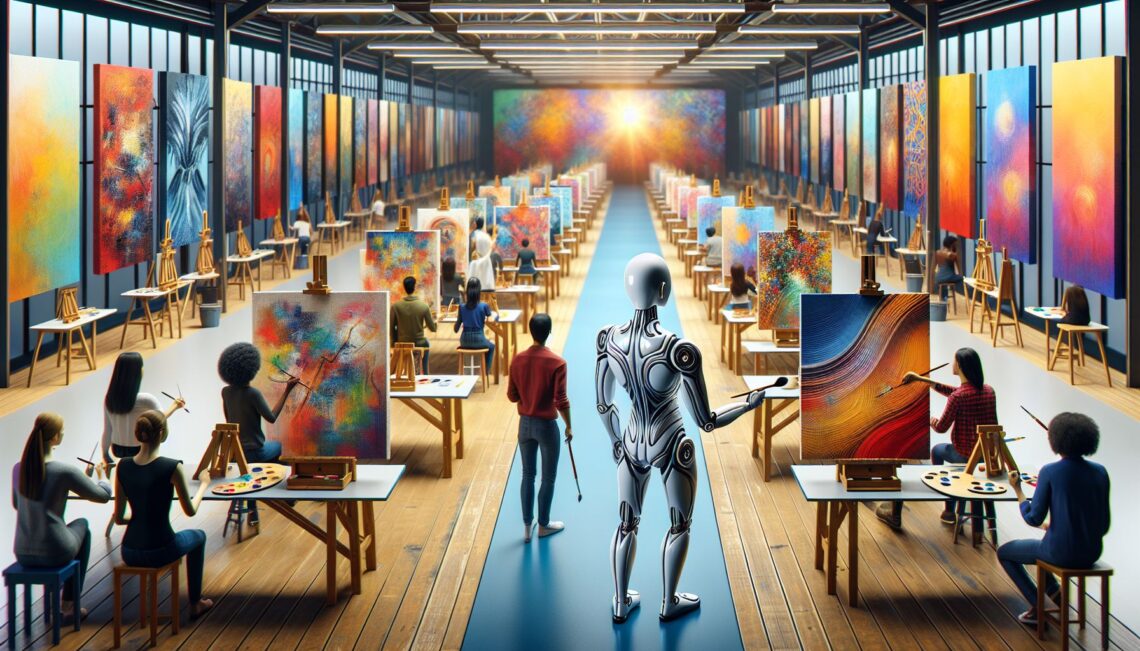
Hey, fellow tech enthusiasts! Today, I want to talk about a topic that’s as intriguing as it is fascinating: Artificial Intelligence in Creative Arts. Yep, we’re talking about art that’s more cyborg than starving artist. Grab your digital paintbrush, and let’s explore this wild fusion of creativity and technology. Spoiler alert: you might end up questioning what it means to be an artist or art lover in a world where AI is as much a creator as inspiration!
The Evolution of Art Meets Tech
Remember the days when the idea of machines creating art was met with skepticism and maybe a bit of ridicule? Fast forward to today, and it feels like AI is the cool new kid on the block, hanging out comfortably in the studio with paints, brushes, and a data-driven algorithm!
From Pixels to Paintings
AI in creative arts has come a long way, from generating pixelated abstract art to crafting high-quality images that can blow your mind. Take OpenAI’s DALL-E, for example. This nifty tool can conjure up virtually anything you describe in text. Want a surrealist image of a banana dancing ballet with an octopus? DALL-E’s got you covered.
The implications here are huge. For starters, artists now have an expansive sandbox for experimentation. There’s no need to be bound by the rigid rules of traditional media when you’ve got a neural network willing to partner up in your creative journey.
Music Meets Algorithms
It’s not just visual art taking the AI plunge, music is getting its algorithmic groove on too. Tools like Google’s Magenta and AIVA (Artificial Intelligence Virtual Artist) are helping composers experiment with melodies they might never have dreamed up on their own.
Imagine being a music producer and having an endless supply of fresh riffs and harmonies to explore. What’s cool is that these tools don’t replace the human artist, they enhance creativity, pushing boundaries while offering novel ways to express musical ideas.
Creative Collaboration or Creative Chaos?
Now, this new era of AI-driven creativity begs some fascinating questions. Are machines co-creators? What does copyright even mean when your collaborator is a machine with a habit of collective learning from an internet’s worth of data?
Who Owns the Creative Process?
In the age of AI art, determining the “creator” of a piece becomes a bit fuzzy. For example, is it the coder who wrote the AI, the artist who fed it prompts, or the AI itself? This is not just an existential question, it’s a legal and ethical one, too. It’s like owning a pizza shop and having to decide who gets credit for a pizza: the baker, the farmers who grew the wheat, or the customer who chose the toppings?
There’s even talk about whether AI-created books, music compositions, or artworks can apply for copyrights. For now, most jurisdictions remain pretty cautious about granting copyright to AI-generated works. It’s like trying to figure out if a cat meme owns its virality, not quite straightforward!
The Fear Factor
There’s a lurking fear in every emerging technology, AI’s no exception. Could AI come for artists’ livelihoods just like autonomous vehicles could disrupt the trucking industry? The underlying sentiment is understandable: will artists become redundant in a world where machines can simulate human-like creativity with ease?
But if history has shown us anything, creative advances generally supplement human ingenuity rather than supplant it. When photography became a thing, did painting die out? Nope. Instead, it evolved, and the two art forms complemented each other beautifully. The same holds true here.
The Future: Utopia or Dystopia?
As it stands, the integration of AI into the arts is far from being a complete, linear journey. Instead, it’s more like jazz, a little chaos, some unexpected harmonies, but ultimately a beautiful piece that’s open to improvisation and interpretation.
The Utopian Dream
In my vision of a techno-utopia, AI paves the way for a world brimming with creativity. Artists no longer bound by the limits of their skillset can instead focus on the emotional and conceptual depth of their work. They leave the technical nitty-gritty to algorithms, just like sculptors leave chiseling to power tools.
Imagine galleries showing a smooth blend of human and machine creativity, art that’s both touchingly personal and surprisingly innovative. In this utopia, young, aspiring artists might spend their evenings tinkering with AI, crafting works that blend traditional sensibilities with digital novelty. Like a DJ but with paint!
Balancing Act
However, this utopia’s shimmer involves ensuring tech-guided creativity doesn’t widen inequality. AI in the arts needs to be accessible, user-friendly, and affordable to genuinely democratize creativity worldwide. After all, the global art landscape could benefit from discovering previously unheard voices given the right tools to flourish.
Conclusion: AI, Art, and Everything In Between
So, where does this leave us on the AI art spectrum? Probably somewhere between curious embrace and cautious optimism. Like any technological leap, the magic lies in how we leverage the tools of the new era while honoring the artistic legacy that precedes it.
Sure, there’s plenty more to explore, debate, and figure out, everything from ethical guidelines to avant-garde aesthetics. But that’s the mysterious beauty of it all, isn’t it? Whether we’re witnessing the dawn of a modern-day Renaissance or just having fun with robots that can paint, one thing is clear: what lies ahead is a wild, wonderful canvas. Let’s make it a masterpiece.
Got thoughts or experiences on AI and art? Drop your musings below. I’d love to hear what you think about our digital da Vincis and algorithmic Amadeuses. Let’s keep the conversation rolling, and here’s to the fascinating fusion of art, science, and the human spirit! Keep creating, keep dreaming, and stay tech-tuned!