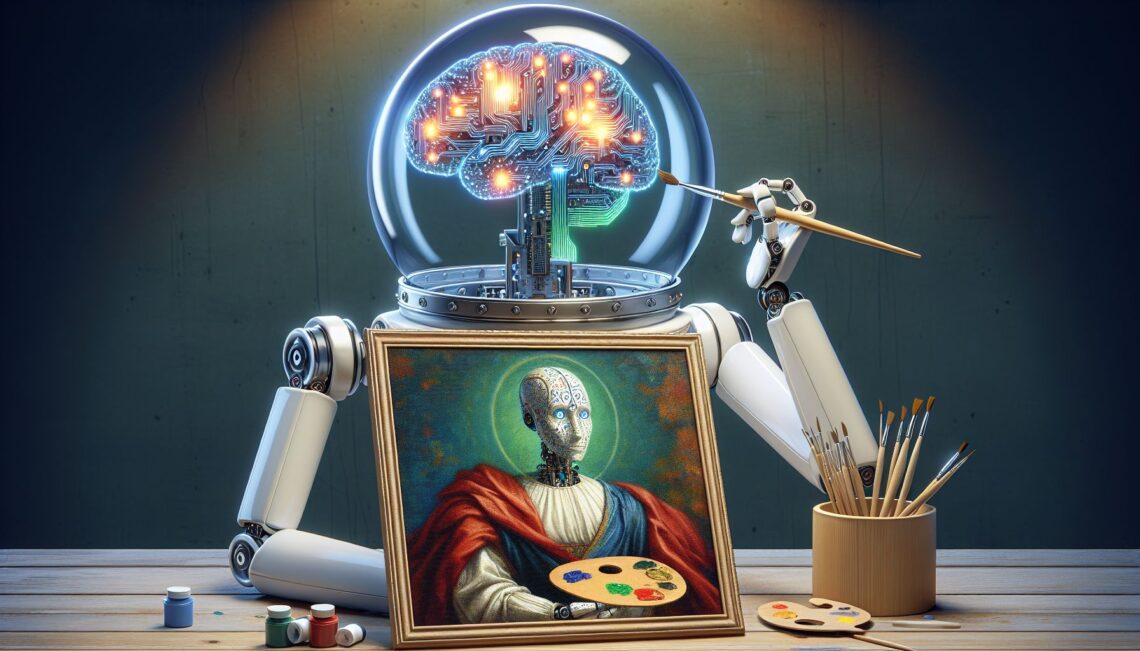
Hey, tech enthusiasts! Today, I’m excited to talk about something that’s been buzzing around like a caffeinated hummingbird — AI in creative arts. From generating music and paintings to writing novels and creating 3D designs, AI is not just knocking at the door of creativity; it’s already barging in. If you’re curious about whether silicon can really inspire the soul, grab a cup of coffee and let’s geek out!
The Genesis of AI Creativity
So, let’s kick things off with a big question: Can machines really be creative? We’ve long thought creativity belonged to humans — expression, emotion, and imagination. Yet, here we are, witnessing something that once lived only in science fiction.
The journey started with AI cracking logic puzzles and playing chess (remember when Deep Blue beat Kasparov?). But the shift toward creativity has completely changed the story. When OpenAI first launched GPT-3, it wrote prose that had some bookworms reaching for their glasses to check if a real author wrote it. Fast forward a bit, and we’ve got AIs generating artworks that sell for millions at auction. It’s as if the robot apocalypse involves not just killer machines but also avant-garde exhibitions!
Art Meets Algorithm
Let’s break down what’s happening in the art world. Generative Adversarial Networks (GANs), the secret sauce behind AI’s artistic capability, work on a kind of sibling rivalry. Two neural networks, the ‘artist’ and the ‘critic,’ duke it out to refine outputs until they create something truly novel or simply jaw-dropping.
One fascinating example is AI’s remix of classic art. Researchers from MIT found ways to blend different art styles, like Van Gogh’s Starry Night revisited with a Picasso flair. These algorithmic mashups are more than just gimmicks; they give us a new lens through which we view art and creation.
Fancy a Tune? AI’s Got Your Back
Now, onto music, where AI’s making waves that are music to our AI-enthusiast ears. Remember when AI-generated pop hit the airwaves, and it turned out to be catchy? Companies like AIVA and Jukedeck are pushing boundaries, composing music that fits everything from Hollywood soundtracks to meditation playlists. It’s a composer’s orchestra, without the temperamental conductor, though with a surefire way to stick to any tempo.
Imagine telling an AI, “Give me a Beethoven symphony with a jazz twist,” and bam! You’ve got your next dinner party soundtrack. While purists may wince at the thought, others see endless unexplored auditory possibilities. Personally, I think it’s like replacing pocket protector liners with symphonic fantasies — unexpectedly delightful!
Writers of the Lost Algorithms
Here’s something for all you Hemingway hopefuls and aspiring Faulkners: AI now writes novels, movie scripts, and articles (irony, much?). GPT-3, our dear friend we mentioned earlier, can whip up a story that you wouldn’t believe was machine-made unless you stumble upon an awkward line or two. It copies styles, understanding context and subtlety with surprising accuracy.
In fact, AI-driven storytelling is more than a novelty. Some publishers are exploring dialogue or plotting ideas created by AI, giving writers a tool that pushes the boundaries of traditional narrative structures. It’s like having a collaborative muse that’s always available and never needs a coffee break.
Challenges? Oh, There Are a Few
Enough cheerleading, let’s talk hiccups. The road to AI’s creative utopia isn’t all glitter and glory. Critics argue about authenticity and the threat to human jobs, especially in fields where creativity is the bread and butter. There’s a difference between encoding empathy and truly feeling it — a gap AI has yet to bridge completely.
Legal issues surrounding copyright, originality, and intellectual property are a regulator’s Rubik’s Cube. If an AI creates, who owns the outcome? The coder, the user, or the AI’s fictitious signature? We are just beginning to figure out these messy questions.
Peeking into the Future
Looking ahead, it’s tempting to imagine an AI-human creative partnership. Picture a world where authors work with AIs to craft immersive worlds, where painters team up with algorithms to explore new visual territories, and musicians transcend old genre boundaries to create novel sounds.
Speculating a bit, could we even see AI creators recognized alongside human masters? Perhaps an AI-generated movie wins an Oscar, redefining ‘Best Original Screenplay’. Although it’s a futuristic leap, the trajectory suggests it’s not impossible.
Wrapping It Up
At the end of the day, AI in creative arts is like finding a new color in the spectrum — exciting, mysterious, and full of possibility. As we stand at this crossroads of technology and art, we might not just witness the art forms of tomorrow but actually shape them. Whether AI will ever understand the true essence of a midnight jazz ensemble or the nuance of an abstract painting remains to be seen. But for now, it’s carved its place, one brush stroke at a time.
Thanks for sticking around, and I hope you found this journey through the silicon clouds as fascinating as I did. Until next time, keep your creativity engines revving, folks!