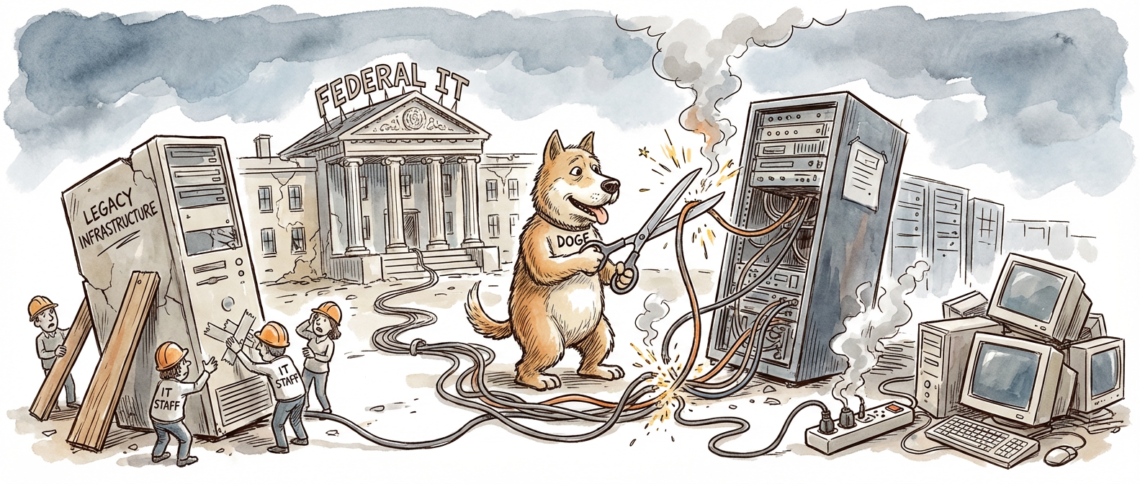
The Surgeon’s Scalpel Meets the Sledgehammer
I’ve spent enough time watching government IT initiatives collapse to recognize the warning signs. When you start cutting personnel and contracts without understanding the systems they maintain, you’re not being efficient. You’re playing with fire in a warehouse full of gasoline.

The Department of Government Efficiency has been active through 2025 and into 2026, targeting agencies like the Social Security Administration, Treasury, and CISA. Thousands of IT and cybersecurity personnel have been let go. On paper, it looks decisive. In practice, it’s the kind of move that gives senior infrastructure engineers heart palpitations because we’ve all seen what happens when you reduce staffing at critical agencies without an operational transition plan.
This isn’t about politics. It’s about how systems actually work. Federal IT infrastructure isn’t built the way consumer tech companies structure their teams. You can’t just subtract people and expect things to keep running. These systems are older, more interconnected, and more fragile than most people realize. Pull the wrong thread and entire payment processing networks can destabilize.
When Your Security Team Gets Smaller During a Nation-State Campaign
Here’s where things get genuinely alarming. CISA lost approximately 130 employees through DOGE-directed reductions in early 2025. That’s not a gentle trim. That’s a meaningful reduction to an agency whose entire job is coordinating vulnerability response across the federal government.
Former CISA Director Jen Easterly testified in early 2025 that cutting federal cybersecurity staffing while nation-state actors like Volt Typhoon are actively targeting critical infrastructure was a strategic own goal. She didn’t mince words. And she would know better than almost anyone alive what the threat landscape actually looks like right now.
The problem isn’t abstract. CISA workforce reduction coverage – CyberScoop documented the real impact on vulnerability coordination efforts. When your vulnerability team is understaffed, disclosure timelines slip. Patches don’t get coordinated properly. Federal agencies don’t get warned about active threats until after the damage is done.
The Treasury Incident That Should Have Been a Wake-Up Call
In February 2025, personnel affiliated with DOGE gained access to the Treasury Department’s Bureau of the Fiscal Service payment systems. We’re talking about infrastructure that processes over 5.45 trillion dollars in annual federal payments. Not millions. Trillions.
This triggered congressional oversight hearings. It should have triggered an immediate halt to further staffing cuts. Instead, it became another data point in a pattern that nobody with actual infrastructure experience should be comfortable with.
The incident revealed something worse than just bad access controls. It showed that the rapid personnel reductions had created gaps in security protocols. When you lay off experienced security staff, you don’t just lose the people. You lose the institutional knowledge about which systems need watching, which access requests warrant extra scrutiny, and how to detect when something isn’t right.
The Vulnerability Database That’s Running On Empty
If you want to understand how this cascades through the entire ecosystem, look at what happened to NIST’s National Vulnerability Database. Beginning in early 2024 and continuing well into 2025, the NVD experienced a prolonged enrichment backlog. Thousands of CVEs sat without proper analysis because the team maintaining the database was constrained on both funding and staff.
NIST NVD backlog status tracker is publicly available if you want to see the numbers yourself. When the vulnerability database starts falling behind, security teams across the entire federal government can’t do their jobs properly. They’re working with incomplete information about what’s actually exploitable.
This is the kind of thing that keeps infrastructure people awake at night. The NVD is foundational. It’s the reference layer that everyone else builds on. You don’t starve it while you’re in the middle of an elevated threat environment. It’s like reducing air traffic control capacity during peak travel season.
Why This Matters Beyond the Immediate Headlines
The real damage from these cuts won’t fully show up for months or years. That’s what makes it such a difficult story to cover and why it deserves more attention than it’s getting. The failures don’t happen immediately. They happen gradually, as institutional knowledge walks out the door and nobody gets hired to replace it.
Federal IT systems are old. They’re complicated. They run most of the services that people actually depend on. Social Security payments. Tax processing. Border security infrastructure. These aren’t new systems you can optimize with modern DevOps practices. They’re legacy systems that require experienced people who understand why every line of code is there and what breaks if you remove it.
When you reduce staffing at these agencies while also cutting CISA and starving the vulnerability database, you’re not optimizing. You’re steadily increasing the probability that something goes catastrophically wrong. The agencies that maintain critical infrastructure need more oversight and resources right now, not less.
This deserves continued attention. If you’re working in federal IT or security, what are you seeing on the ground? The infrastructure community needs to document this moment. What changes have actually affected your work? What’s holding up? What isn’t?